Coco Chanel: The Convent Couturie

"In order to be irreplaceable one must always be different."
-Coco Chanel
Humble Beginnings
Gabrielle “Coco” Chanel didn’t exactly have a soft landing into the world. After her mother died, her father abandoned her and her sister at a convent orphanage, never to return.
There, the nuns taught her practical skills like sewing, cleaning, discipline, and precision. In that structured life, Gabrielle became used to comfortable clothing with clean lines and monochrome colors.
Leaving the convent as a young woman, the expectation at the time was that someone in Gabrielle’s circumstances would find modest work in a kitchen, laundry, shop, or factory, using the practical skills she had been taught to earn a simple living and, if fortunate, marry for security.

Image of Gabrielle "Coco" Chanel as a child sourced from Women in Fashion
Finding Her Place
But Gabrielle was not ready to settle quietly into the life expected of her. Driven by curiosity and ambition, she moved through boarding houses and found work performing in cafés and smoky little music halls, where she sang light comic songs such as Qui qu’a vu Coco? and Ko Ko Ri Ko. She performed often enough that audiences began calling her by the nickname that would follow her forever: Coco.
While Coco was never the greatest singer, she learned something more valuable than applause: attention. Men noticed her, society watched her, and she watched right back, studying how people with wealth and power carried themselves, dressed, and moved through the world.
Then came wealthy cavalry officer Étienne Balsan, who introduced her to a world of estates, horses, and luxury, giving her a front-row seat to elite society. Yet Coco had little interest in the heavily corseted, ornamented styles fashionable at the time. She tailored her own simple riding clothes and clean hats while others were buried in feathers, lace, and fuss.

Arthur "Boy" Capel with Gabrielle "Coco" Chanel in 1908 sourced from Research Gate
Entering The Hat Business
Later, English businessman Arthur "Boy" Capel believed in Coco's talent enough to help finance her first shop.
In 1910, she opened her first store on 21 Rue Cambon. Parisian business rules at the time restricted what could be sold in certain prime locations, so she she was only able to sell hats. Her hat designs were lighter, cleaner, and more modern than the oversized, heavily decorated styles fashionable at the time.
Stylish women noticed, and actresses began wearing them, helping spread her name in Paris society.

1910 Portrait of Coco Chanel hats sourced from Chanel
The Shift to Clothing
While selling hats in her store, her customers would complement her simple yet chic outfits, asking where to buy them. Since Coco wasn't able to sell anything more than hats in her Parisian location, she expanded to the seaside resort of Deauville in 1913, where wealthy clients wanted relaxed clothing for holidays, walking, sport, and travel.
Instead of formal, restrictive fashion, Coco created easy garments inspired by menswear and practicality. She used jersey fabric, then considered too humble for luxury fashion, to make comfortable pieces women could actually move in.
Demand grew quickly, and in 1915, Coco opened a larger house in Biarritz, another glamorous resort town filled with wealthy international clientele. The business flourished there during the World War I years, when simpler clothing also matched the changing realities of the time.
Chanel's resort boutiques proved the business model. Her name spread through wealthy social networks, actresses, and repeat customers.
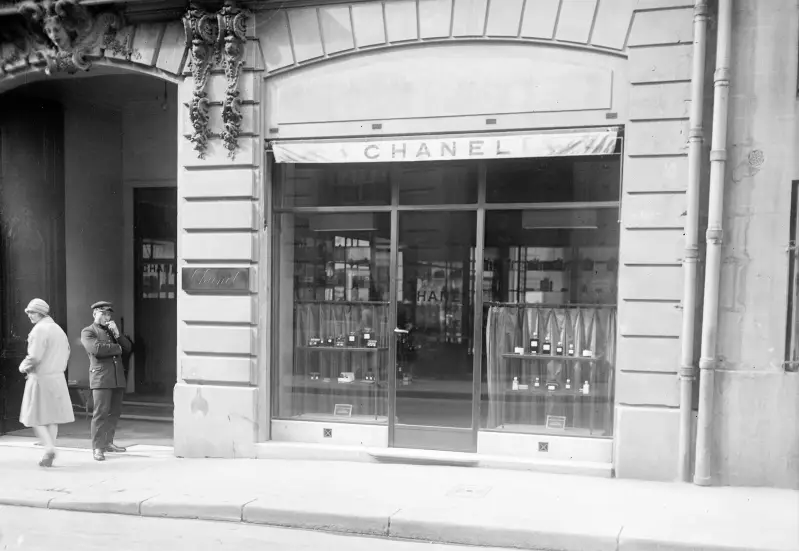
By 1918, Coco had earned enough success to expand in Paris to 31 Rue Cambon, where she established a couture salon and fashion house that would become one of the most famous addresses in style history.

The Little Black Dress
From there, Chanel's influence accelerated.
She made simplicity luxurious, comfort elegant, and restraint powerful. She stripped away excess while preserving glamour.
In 1926, Coco introduced her most iconic creation: the Little Black Dress.
At the time, black was associated more with mourning than modern style. Coco saw something else entirely: simplicity, versatility, and quiet power.
She was right. The Little Black Dress became a universal symbol of chic. It fit every generation, every occasion, and nearly every era that followed. She simplified silhouettes, freed bodies, and gave women permission to wear elegance without excess.

Photo of Coco Chanel In Little Black Dress Sourced From Diplomatic Press Agency
Not Finished Yet
Coco closed her shops during World War II and spent years out of fashion leadership. By the late 1940s and early 1950s, Christian Dior’s “New Look” dominated fashion with tiny waists, structured shapes, and dramatic volumes of fabric.
Coco believed women needed freedom of movement, not a return to restriction. So in 1954, at age 71, she reopened her house and introduced what became the signature Chanel Suit: a collarless tweed jacket, practical pockets, soft shoulders, and effortless polish without stiffness.
The French response was cool at first, but American women embraced it. Soon the suit became iconic and was worn by women from executives to Jackie Kennedy to royalty and actresses.
Gabrielle Chanel began with almost nothing but discipline, instinct, and nerve. She ended by reshaping how women moved through the world.

Signature Chanel Suit sourced from PR Report