Hedy Lamarr: The Genius Ingenue

“Give the world the best you've got. And you will get kicked in the teeth. Give the world the best you've got anyway.”
-Hedy Lamarr
Early Life
Hedy Lamarr was born Hedwig Eva Maria Kiesler in Austria in 1914. She grew up in Vienna, where her father encouraged her curiosity by explaining how machines, streetcars, and everyday systems worked. From an early age, she showed both intelligence and imagination.
As a teenager, her striking beauty opened doors into European film, and by her late teens she had become a rising actress. In 1933, she married wealthy arms manufacturer Friedrich Mandl.
At lavish dinners and business meetings, Hedy listened as military men and industrialists discussed weapons, communications, and wartime technology.
She absorbed this knowledge that few women were expected to understand, let alone use.

Hedy Lamarr Photo Sourced From Hedy Lamarr Website
The Escape
Though the marriage gave Hedy access to elite circles, it also confined her.
Mandl was known for controlling behavior and reportedly tried to limit Hedy's independence and closely monitored her movements.
Determined to reclaim her freedom, Hedy fled the marriage in the late 1930s, eventually making her way to London. There she was noticed by Metro-Goldwyn-Mayer executive Louis B. Mayer, who brought her to Hollywood and renamed her Hedy Lamarr.
Soon, she was promoted as one of the most glamorous women in the world.

Hedy Lamarr in Ziegfeld Girl Sourced From Forbes
In Between Takes
In Hollywood, Hedy Lamarr was marketed for her beauty, but her real interests extended far beyond the screen. Between film shoots, publicity appearances, and studio obligations, she spent her spare time sketching ideas, studying mechanics, and experimenting with inventions. She worked on practical concepts ranging from household improvements to traffic signal designs, always looking for ways things could function better.
During World War II, her curiosity turned toward a far more urgent problem: military communication. In 1940, she met George Antheil, a composer known for his work with synchronized mechanical systems. The two bonded over a shared interest in engineering and a desire to help the Allied war effort.
Together, they developed a secure radio guidance system for torpedoes that could rapidly shift between frequencies, preventing enemy forces from jamming the signal. Their design was innovative, practical, and advanced enough to earn a U.S. patent in 1942.

Image of Hedy Lamarr Sourced From The New Yorker
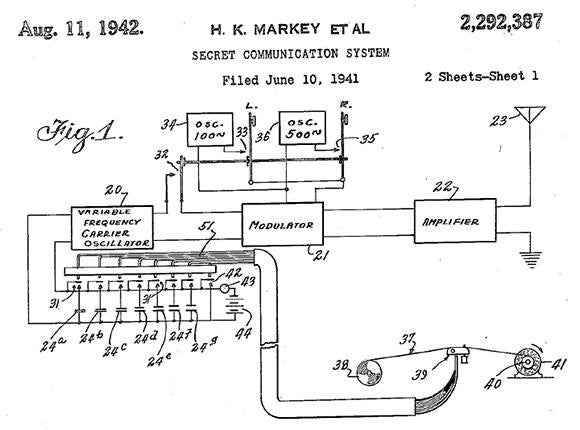
Drawing from a US patent application filed by Hedy Lamarr and George Anthiel sourced from SPIE Defense & Security Society
The Overlooked Invention
After securing their patent, Hedy Lamarr and George Antheil offered the frequency-hopping system to the U.S. Navy as a way to protect radio-guided torpedoes from enemy interference. On paper, it solved a real wartime problem. In practice, military leaders were skeptical of an idea coming from a movie star and a composer, and the technology was considered too unconventional and complicated for immediate use.
Rather than seriously developing the invention, officials encouraged Hedy to support the war effort in a more familiar role by using her fame to sell war bonds. She did exactly that and helped raise millions, but the message was clear: her beauty was welcomed, her intellect was not.
Many people would have accepted the dismissal and moved on. Hedy did not. While continuing a demanding Hollywood career, she kept sketching ideas, refining concepts, and treating invention as more than a hobby.

Hedy Lamarr promoting war bonds sourced from History Rat
The World Finally Catches Up
Decades later, as engineers worked to solve the growing need for secure wireless communication, older patents and early signal-spreading concepts were revisited. Researchers recognized that the same core principle Hedy and Antheil had proposed in 1942 could be applied to a new technological age. What had once seemed impractical was now exactly what the modern world needed.
By the 1980s and 1990s, spread-spectrum technology had become an important part of wireless systems used in Wi-Fi, bluetooth, GPS, secure military communications, and wireless networks around the world
In 1997, at the age of 82, and 55 years after receiving the patent, Hedy was honored with the Electronic Frontier Foundation Pioneer Award, one of the first major public recognitions of her work as an inventor. She died in 2000, after finally seeing the world begin to appreciate what she had helped create. In 2014, she was posthumously inducted into the National Inventors Hall of Fame.
She had once been celebrated for her face. In the end, history remembered her mind.

Hedy Lamarr induction to National Inventors Hall of Fame